
The setup
The exciting and exhausting journey of launching Third Space had recently ended with us settling into order. The next day, a parents’ meet was planned. A panel discussion would follow, where a few colleagues would speak about their journeys – what had been difficult, what had held, what had slowly come together – and their families would witness their workspace.
Hitesh, one of our colleagues tirelessly working to make launch day a success, was a panellist. Public speaking had never been easy for him.
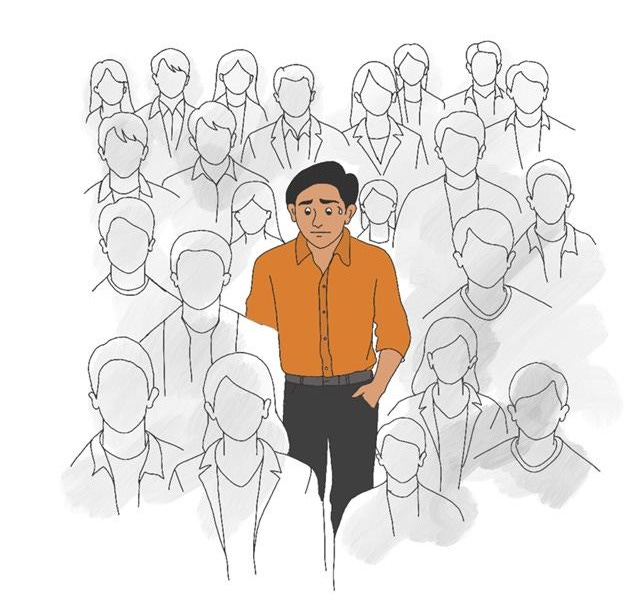
His hands shook. The stage was unfamiliar territory. He often felt his heartbeat rise louder than his own voice.
He jotted some points down, anyway, folded the paper and slipped it into his pocket.
The missing pages
On the day of the event, the paper stayed behind — left in another pocket, in another set of clothes. He realised it only after reaching the venue.
He checked his bag once. Then again.
Nothing.
The questions he had gone over a few days ago suddenly felt distant. He could remember fragments, not full answers. He stood near the side of the room, asking colleagues what they thought might be asked. He repeated possible responses under his breath.
It wasn’t panic. It was a steady, uncomfortable awareness: I don’t have the backup anymore.
What made it harder was the audience. His parents were sitting in the front row. They hadn’t attended many of his school events growing up. Now they were here, looking toward the stage, waiting. That thought kept returning as he waited for the panel to begin.
On stage
As the discussion started, Hitesh listened carefully to each speaker before him. He tried to track the flow of questions, guessing which one might reach him.
When the questions finally turned towards him, he stood and took the microphone.
For a few seconds, nothing came out.
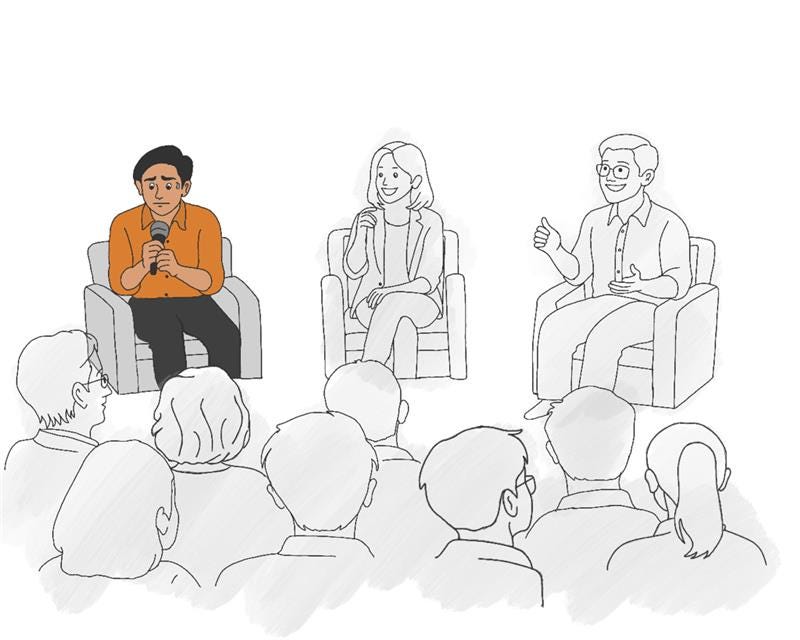
He folded his hands and said, khammaghani. His voice felt thinner than usual. He cleared his throat. Then he looked toward his parents. That part felt natural. Easier than answering anything about work. Then he began.
The first few lines didn’t come out the way he had rehearsed them. He paused midway through a sentence, adjusted the wording, started again. He moved between Hindi and English without planning to. Sometimes he lost the exact point he wanted to make and had to circle back to it.
His hands trembled slightly around the microphone. He shifted his weight to steady himself. He wasn’t smooth. He wasn’t dramatic either.
He spoke about the work — the pressure before launch, the confusion, the learning curve, the fear of standing here at all. Some answers were shorter than he had imagined. Some felt clearer because he wasn’t trying to remember exact lines.
He didn’t stop feeling nervous. But he didn’t stop speaking.
What stayed with us after
This story is not really about a missing script; It is about being seen in the moment you feel least prepared.
Hitesh did not speak perfectly that day. He paused. He reshaped sentences. He searched for words. But his parents saw him stand there and try. They saw the trembling hands. They heard the hesitation in his voice. And they watched him continue anyway.
That possibly changed something.
We, at Dharohar, do not always know exactly what these moments will produce. Sometimes they are awkward. Sometimes emotional. Sometimes uncertain. But when we allow families to step into the spaces where work usually stays contained, something honest surfaces.
Perhaps when families enter a workspace, the work shifts slightly. Perhaps it is no longer only about targets or roles – instead it tends to become visible as effort, risk and growth.
For Hitesh, the moment mattered because his parents witnessed not just what he does, but who he is becoming while doing it.
Maybe that is what stayed. The fact that work and family briefly shared the same room, and nothing was hidden.