
A broom is an ordinary object. It leans against walls, rests in corners, and blends into everyday life. It also became an inseparable part of Jungle, the green space Dharohar adopted and continues to nurture, inspired by local grasses in the area.
This was our idea of brooms too, until the day Nandita ma’am sent a set of broom designs from Alaska.
Printed images were passed from hand to hand. Our team huddled to take a closer look. The designs looked nothing like the brooms we were used to making. Thin and thick lines moved together in careful balance. They also curved at places instead of running straight. The tying at the top was unfamiliar – tight, deliberate, precise.
These were not decorative changes. They required a different way of working — one that began by slowing down. The designs held the room for longer than expected. People kept coming back to the same lines, tracing where they thickened, where they curved, where control would be difficult. It took time to see what they could make of the design, for craft is often not about beauty or inspiration. It demands meticulous effort, attention to detail and discipline.
The process felt a bit like the moment before weaving begins at a loom. The frame is ready, the thread is there, but the pattern must be read first. Where will the tension in the strings arise? How much should the yarn be twisted? Such questions must be answered before any work could start.
Everyone seemed to look at the designs in their own way. One person checked the balance of the lines, another followed how they curved, someone else kept returning to the knot at the top. The act was deeply meditative. Much like the weaving process, no one began until they studied how the pattern would hold, where it might loosen, and where it needed control. Understanding came slowly and unevenly.
The question, still, was not can we make this?
It was can we risk making it exactly like this?
To risk, or not to risk?
After discussion, a collective decision was made. The designs would be attempted just as Nandita ma’am had shared them – no shortcuts, no early adaptations.
It was not a comfortable choice.
The raw material lay stacked nearby, limited and precious. Every mistake would mean loss. Every failed broom would need to be broken apart. There was no guarantee the unfamiliar technique would ever settle into their hands.
Still, the decision stood.
The desire to try was strong enough.
The days that followed were slow and heavy.
Every morning, Jungle supervisors and our team sat together on the floor, the designs placed between them. Someone suggested bending a section inward. Someone else demonstrated how the knot at the top might be formed. Hands moved cautiously, testing pressure, loosening and tightening fibres.
Often, a broom would be completed and stood upright. Everyone would step back. Heads would tilt. Silence would stretch.
Then, quietly, the broom would be taken apart.
The sound of fibres being loosened filled the space more often than not. There was frustration in the room. Added to this was the constant worry of wasting material. Yet no one walked away.
Slowly, something began to take shape.
Muscle memory
Within a few days, the shift became visible.
The same members who earlier struggled to complete simple patterns now moved faster, more confidently. Their hands remembered where to bend, how tight to pull, when to pause. The curves grew smoother. The grip stronger. Time reduced.
Finished brooms were held up for others to see.
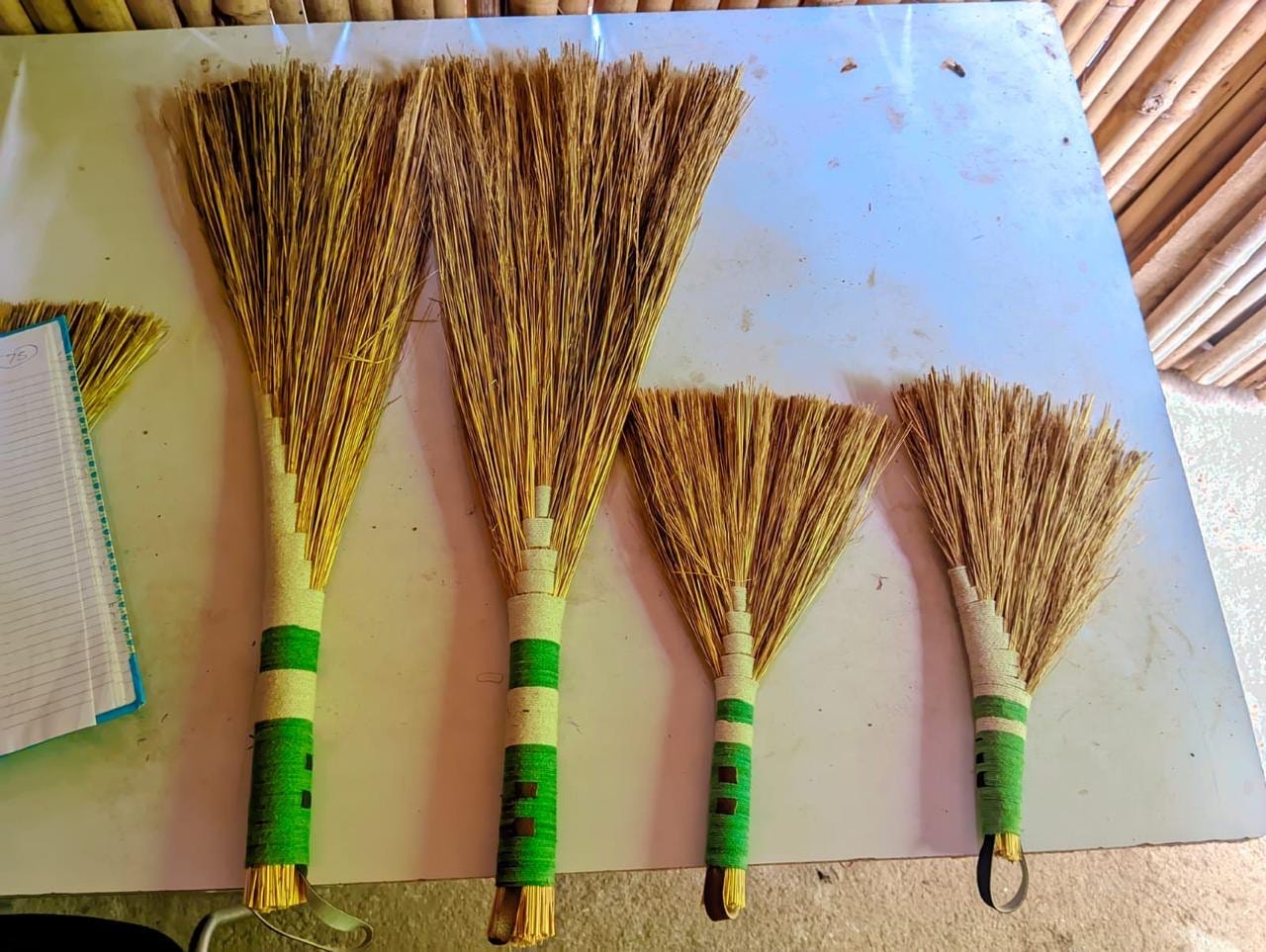
You could see it on their faces – the hesitation lifting, assurance visible. What once felt impossible now felt achievable.
Sometime later, Nandita ma’am sent more designs. New patterns. Different techniques.
This time, the reaction was immediate. People leaned forward eagerly. Conversations overlapped. Everyone wanted to try first. The same designs that would once have caused silence now sparked excitement.
The workspace looked different now. Multiple brooms lay side by side. Three, then four distinct styles began to emerge. The weaving was clean, the grip solid, and the finishing careful and consistent.
What had begun as an experiment gradually turned into skill.
Limelight ka litmus test
The real test came on Hariyali Amavasya, at the first large stall set up in Udaipur.
Brooms were arranged carefully on the stall. Sunlight caught the curved patterns. The fibres gleamed softly. For a moment, the stall stood undeterred in the sea of curious eyes and whispering mouths.
Then people began to stop.
Interested, they picked up the brooms, turning them over in their hands. Fingers traced the unfamiliar designs.
“These are handmade?”
“By forest and local folk?”
“Here?”
Surprise gave way to admiration.
People didn’t just pause – they stayed. They asked questions. They compared designs. And then, they bought.
For our team behind the stall that had invested in this project, this moment mattered. It was important that their work was not being seen as novelty, it was becoming a part of everyday households.
Later at our annual flagship event, MASST, the scene returned.
Questions came again:
“Is this really handmade?”
“Where did you learn this technique?”
Behind the stall, our team exchanged glances and small smiles. Pride and contentment clearly visible on their faces as their work travelled beyond Jungle and beyond expectations.
Around the same time, this thinking carried into another public space — the Garden at Pal, a flower show by Fateh Sagar Lake. Instead of focusing only on ornamental plants, our contribution to the flower show made room for the city’s local grasses — the kinds people usually overlook, step past, or cut away without a second thought. Seen together, they revealed a layered beauty rooted in the local landscape of Udaipur.
Here too, brooms became part of the conversation. They were displayed not just as finished objects, but as outcomes of a process — shaped by skill, patience, and practice. Visitors were invited to try their hands at broom making themselves. It didn’t take long for them to realise how difficult the work actually was. What looked simple, even ordinary, quickly revealed the labour behind it.
What this story leaves us with
This is a story about what happens when people are trusted with opportunity – even when there is risk involved. When they are allowed to try, fail, break, remake, and try again.
It is also important to say this clearly; we are not perfect.
We make mistakes. We sometimes underestimate how hard a process will be, or how much support it will need. We introduce opportunities that do not arrive with clear answers. This project also had its own imperfections. There were moments when the risk felt too high, when material was lost, and when better planning might have eased the journey.
But we chose not to step back.
We stayed with the work. What emerged was gradual transformation discovering that day- to-day efforts reflect risk taking, leap of faith and uncompromised experimentation.
It is equally important to recognise those at the centre of this work. Supervisors from Jungle who make these brooms carry skills that cannot be picked up casually. If we were to sit down and try to make these brooms, we would struggle. Its simplicity is held together by experience, practice, and familiarity with material and technique. Their labour deserves to be seen, respected, and credited.
At Dharohar, this is the work we believe in.
Not getting everything right – but staying responsible to the process.
Not avoiding risk – but standing alongside those who take it.
Sometimes, all it takes is an ordinary object, and the courage to imagine what else it could become.