
What’s the purpose of “organisational values”?
Every company, not-for-profit, or start-up has them. Even Dharohar does.
Words like ‘Integrity’, ‘Courage’, ‘Transparency’ – they look good in an employee handbook or framed on a wall. But are they just nice-to-have keywords? Are they there to make the organisation look and feel serious?
Or are they supposed to be actually followed? And guide us in what we do every day?
It’s a fair question.
At Dharohar, we try to make them real. Not in a self-righteous “we’ve figured it all out” way, but as a constant, daily attempt. This story is about one of those attempts. It’s not a dramatic, public-facing win. It’s a quiet, personal story that, in hindsight, showed us exactly what living our values looks like.
It’s the story of our colleague, Seema*, and a choice she made when she was stuck, stressed, and no one else was watching.
[Editor’s note: We’ve changed our colleague’s name for this story.]
The 2 AM Problem
The incident took place in July 2023. It was the frantic pre-launch period for Third Space, and the team was working day and night.
If you’ve been to Third Space in Udaipur, you’ll know it’s a vibrant public hub with a library, a makerspace, art studios, and community corners. It’s a massive, multi-faceted space. And at the time, we’d never done anything at this scale before. Seema was deep in the logistical trenches, managing travel and stay for nearly 70 visiting food workers – across multiple different hotels.
On one of those chaotic nights, around 2:00 AM, a panga struck.
The owner of one of the booked hotels called, furious. About 50 of our guests had just arrived, and a full-blown fight had broken out. The group was aggressively clashing with the hotel staff – maybe about unclean rooms, maybe just exhaustion and misunderstanding. The hotel owner was equally aggressive, shouting to Seema that he refused to host “such people.”
Seema found herself trying to mediate a shouting match in the middle of the night, pleading with the owner. Where else could 50 people go at this hour? She called her colleague for support. He managed to get the group’s head chef on the line, who in turn spoke to his team and calmed the group down.
A tense, temporary peace was brokered. The hotel owner reluctantly agreed to house them. For that moment, Seema thought the problem was now over.
Little did she know that the real panga, the one that quietly tested her resolve, would begin a few days later.

The Awkward Call
The launch was over. It was time to clear the invoices. The same hotel owner called Seema, but his tone was completely different. He was, as she put it, “exceptionally happy.” He had, after all, made a significant profit from the large, multi-day booking.
He told Seema he wanted to “return the favour.”
It was a favour nobody wanted. In fact, for Seema, she had given no favours; it was a business transaction. We had people who needed a place to stay; he had a hotel. We used the service; we paid the bill. Done. What favour was there to return?
But the owner had something else in mind. He offered Seema a “personal commission.”
He didn’t dance around it. It was a clear offer of a bribe, a rishwat, for giving him the business.

Seema was taken aback. She refused. “No,” she said. “That’s against my personal values. If you want to offer a discount because of the business, please apply it to the company’s invoice.”
He refused. He wasn’t interested in giving Dharohar a discount; he wanted to give her a cut. He kept pushing, telling her she could take “as much as you want.” He even offered to arrange a lavish “five-star dinner” for her and her husband.
Seema was stuck. The owner kept pestering her, call after call, for five or six straight days. The calls, she said, “ruined her mind.” She was terrified and felt the “very awkward feeling” around the whole situation.
She couldn’t just block his number. She couldn’t just tell him to get lost. The hotel’s final invoice, the very thing they were “discussing,” was still pending payment. She was professionally trapped, forced to remain polite to a person who was actively harassing her and putting her in an impossible ethical bind.
The Price of Integrity
Finally, the invoice was cleared. The payment was processed. The professional tie was cut.
Now she could act. She told the owner, in no uncertain terms, to never call her again. Then she blocked his number and internally, made a permanent decision: she blacklisted the hotel.
She didn’t blacklist the hotel because of the 2:00 AM fight. Bad service, unclean rooms, aggressive staff – those things are fixable. People have bad days. Operations can be improved.
This was different. This wasn’t an operational failure; it was a values failure.
It wasn’t just the personal harassment, though that was certainly part of it. It was a question of integrity. It was a fundamental misalignment in beliefs, in the right and wrong way to do business.
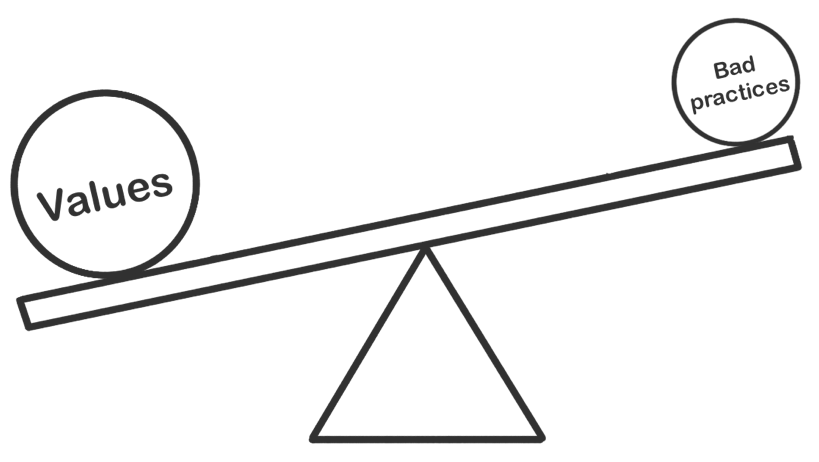
It means we now have one less hotel in our vendor pool, which might mean having to find a more expensive or less convenient option next time. It means we sometimes say no to sponsors or partners we’d love to work with, because we realise our values just don’t align.
Seema wasn’t consciously thinking about Dharohar’s “values PDF” in that moment. She wasn’t running through a checklist. She just did what she felt was the right thing to do. And in doing so, her personal integrity and the organisation’s integrity became the same thing.
But it leaves us with a real, messy question: how do you stick to your values when it makes your work harder? How do you do the things you want to do, at the scale you want to do them, without making compromises you’ll regret?
We don’t have a perfect answer. It’s something we’re still figuring out.