
Sometimes you look back at a project and you wonder… “What were we even thinking?”
It’s a question we ask ourselves sometimes… if not a lot. And today, we’re looking back at one of our most ambitious projects, a mad journey that still makes us shake our heads.
This is the story of the launch of Third Space Cinema: the largest, most technologically advanced cinema in Udaipur.
And it’s the story of how we handed this massive, complex, high-tech project to a colleague who, in his own words, “didn’t even know what an IP address was”.
This isn’t just a story of grit and teamwork, though it has all of that. This is a story about the great Murphy’s Law: “Anything that can go wrong, will go wrong.”
And oh, did things go wrong.
The ‘Pagal’ bet
Our dream was simple, really. We have one for everything we do: to prioritise the “Visitor Experience and Quality of Excellence”. We wanted to create a world-class space for the community to watch learning-based films, documentaries, and even the occasional blockbuster.
So, we went all in.
We’re talking about a state-of-the-art Barco SP4K-25 laser projector, full Dolby ATMOS 7.1 sound system, and the works. Honestly, we probably hadn’t even heard of half this stuff. We just knew we wanted the best, most “user-friendly” experience.
Now, who do you hire to run a project this complex? A seasoned IT integrator? An expert projectionist flown in from Mumbai?
We did the opposite. And that was a deliberate choice.
Our ‘dharma’, as we saw it, wasn’t to hire one or two expert projectionists. It was, as Praveen later said, “to take the people we have... and based on their interest, turn them into expert projectionists”.
So, we handed the project to Praveen, a key member of our Visitor Experience team.
There was just one small panga. This was a tech project, and Praveen, by his own admission, was a “non-tech” guy. His first challenge? A vendor asked him for an IP address. He got so worried about being responsible for the info that he went out and “bought a Lucent Publication computer book,” where, he says, “I learned for the first time that the full form of IP address is Internet Protocol”.
Still, we believed in our people. We got it rolling. We had no idea what was in store.
Pange ke upar panga
We knew it wouldn’t be easy. It was new for all of us. But we didn’t just face one panga. We faced a bunch of them. It felt like the universe was conspiring against us.
First, there were the partners.
To run a modern cinema, you are completely dependent on big corporate vendors for ticketing and tech integration. And they were… difficult.
We faced “harsh language” from a partner’s manager. This led to a full-blown “tu-tu main-main” in the very first meeting between our IT head, and their manager over something as basic as a “Firewall Policies Template”. After that, Praveen had to act as a “third-person communicator” just to get them to talk.
At one point, the work was stuck in a ridiculous fight over “HTTP vs. HTTPS,” a security setting one partner refused to adopt.
Then, for two months, their corporate team refused to handle movie scheduling over official email. The only reason we got any movie schedules at all was because of Praveen’s personal dosti with his contact, who was bending the rules for him.
As if that wasn’t enough, the tech itself decided to self-destruct.
One late night, Praveen got the call. He had just reached home after a three-hour commute, and his mother was calling him for dinner. It was a software crisis: the core server installation had failed, triggering a virus alert.
Praveen, stuck three hours away, immediately got his seniors on a conference call. This kicked off a “high-stakes blame game” between our IT team and the vendor. Praveen’s biggest fear? That he’d be responsible for malware on the main server because he’d been “too trusting” of a “novice” vendor team.
How do you even manage this kind of “war-like” situation”? Where everything is just a… mess!?
Praveen recalls sitting with Ketan, a senior colleague, who asked him how he was managing all this chaos. “I write in a diary,” Praveen told him.
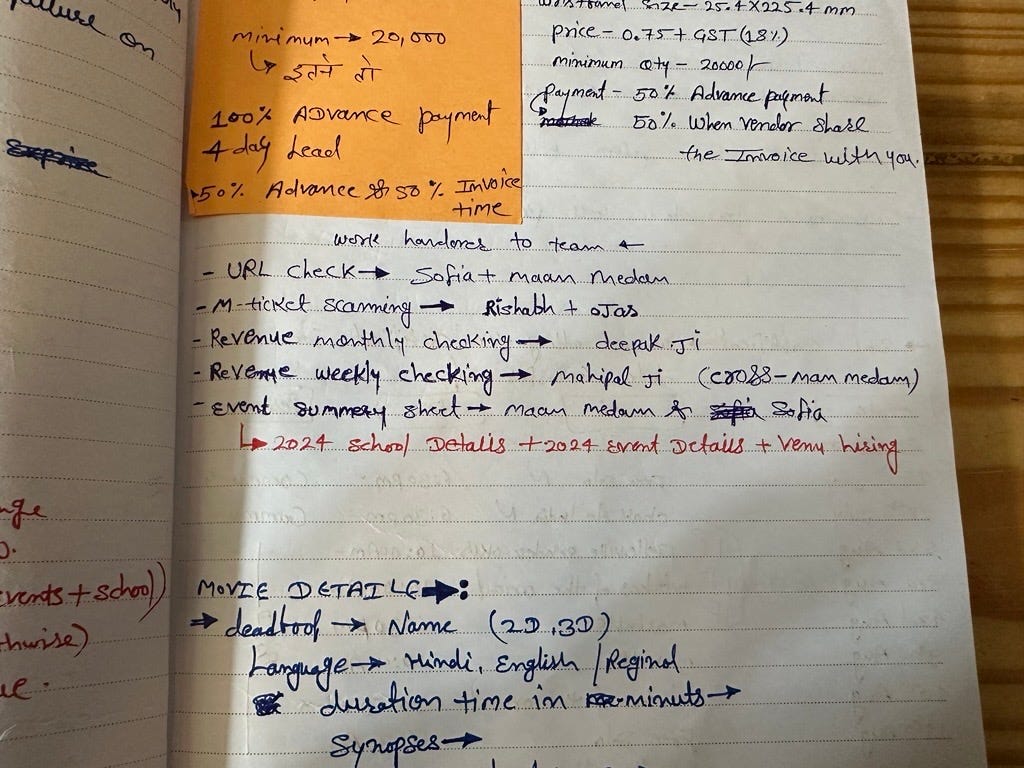
Ketan’s advice was simple and transformative: “You can’t show our partners and colleagues a diary. You need to make an Excel sheet. Write down everything that has happened, day by day. If someone asks how much is done and how much is left, you need to show them a sheet”.
That suggestion was a turning point. That Excel sheet became the map. It wasn’t a magic wand – Praveen also used a jugaad of “red and white threads on a physical plan” to track dependencies – but it turned the chaos into a to-do list.
It was a good thing he started, because the pangas weren’t over…
There was a big one still left – we discovered that three months of our ticketing data was corrupted.
A quarterly check revealed that because new team members were struggling with a complex data sheet – and a website design that “merged cells” – the data was a mismatched mess. It all had to be cleaned. Manually. One. By. One.
So here we were. Our partners were hostile. Our server was on fire. Our data was a mess.
And it was in the middle of all this... that our hard launch deadline – 11 May 2024 – flew right by.
There was no last minute miracle. No late nights that could speed it up. We just couldn’t make it. We failed.
The deadline wasn’t just missed; it was obliterated. This isn’t one of those last-minute-win stories. It’s a story about a public failure. We had to put up a “Coming Soon” sign on our biggest, most hyped-up feature.
And sometimes, you just have to accept that, take a breath, and figure out what to do next.
The 77-day gap
The “lage raho” phase… just continued. The 77-day gap between the missed deadline and the final launch was where the real grind happened.
The server crisis that started in April? It finally got resolved in June.
The corrupt data? The team just sat and manually fixed three months of entries, a process that led them to redesign the data sheet to be simpler for everyone.
The hostile partners? Praveen, now armed with his spreadsheet, kept getting on calls, kept pushing, and kept using his interpersonal skills – eventually making a personal appeal to their senior, who finally got the work moving again.
And it was the team, who “had never even connected an HDMI cable” before, spending time in the projection room, learning the machines, and teaching each other.
The launch (and the real ‘win’)
On 27 July 2024 – 77 days late – the cinema finally opened. The Olympics were happening in Paris, so we screened sports-based movies for school kids. We also got some French language films screened
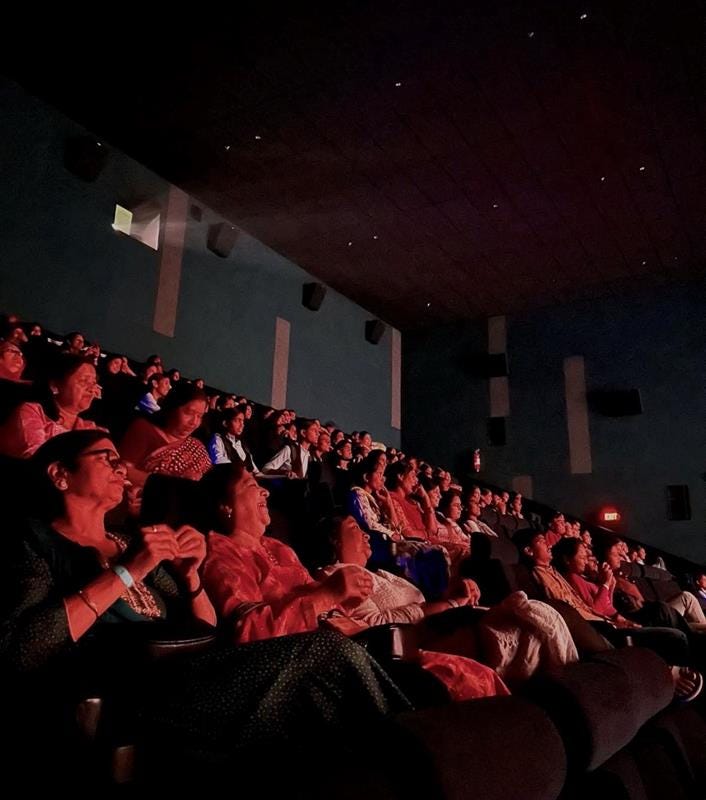
So, what was the real “win” here? It wasn’t just an open cinema.
It was a messy, chaotic validation of that “mad” bet.
The team members who were new to computers are now running the whole show. They even try to solve IT-related problems themselves first, before calling the IT team.
Praveen, the “non-tech” guy, is now an expert. He’s one of the “less than 1%” of people in the world, as he proudly says, who can run this entire system.
As he puts it, “I now consider myself a ‘seekhne wala baccha’ who is not afraid of any challenge, but rather sees it as an opportunity to learn”.
What we’re still wondering
This is the Kahaani Junction, not a fairytale. We’re proud of the team, but we’re left with messy questions.
We lived up to our belief, but at what cost? Was the stress on the team worth it?
We learned that we should hire for “curiosity” and “problem-solving”, but how do we build better processes so we don’t have to rely on one person’s grit (and a personal dosti with a vendor) to save a project?
And,
We built a world-class cinema for “learning-based movies,” but what do we do when we see that audiences, reasonably, just want to be entertained?