
Visitors entering the Biotech zone in Third Space’s Frontiers are greeted by a giant DNA genome model overhead.
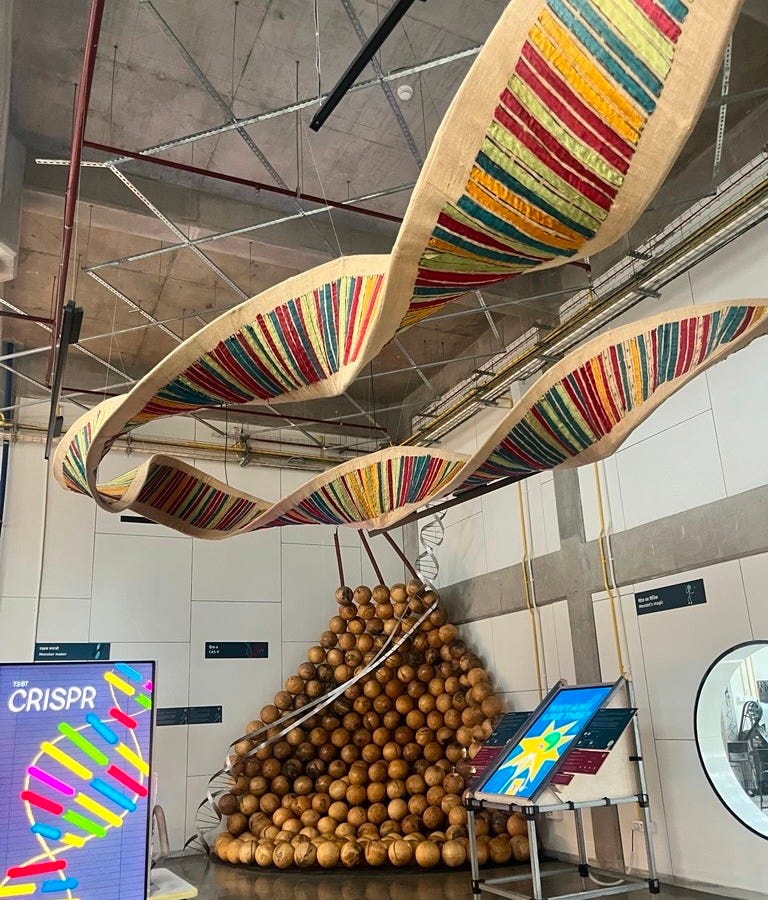
It is ambitious in both scale and intent: a DNA model stitched from fabric with coloured threads representing different genetic bases, hanging in mid-air. Yet what makes it remarkable is not only its size. It is that the structure was built collectively.
The idea was simple. Long strips of fabric would be embroidered using coloured threads, each colour representing a different genetic base. These stitched sections would then be joined together to form the complete structure. Part scientific model and part collaborative artwork, the installation relied on thousands of individual stitches.
Yogita remembers thinking about everything it would take to do this: the metres of fabric, the coloured threads, the thousands of stitches and the sheer amount of repetitive work. It soon became clear that the project was too large to stay in one place. The next step, she thought, was to take the work to people.
Soon, fabric, coloured threads and needles were travelling between MIA, PIA, BIA and the Khoj Centre at Celebration Mall, inviting people of all ages to participate in an unusual exercise in sewing and science.
What emerged was a collaboration. People who would never normally work together were in conversation. Students, young children and elderly women all became part of the project. Interestingly, instead of working from a finished model, they stitched only the section assigned to them, following colour patterns and instructions given. They would also refer to the segment that had already been completed before theirs. Once finished, that piece would travel to another person or another centre, where the next section would continue from where the previous ended. Slowly, one fragment after another, the genome began to take shape.
There was a small parallel with the history the installation referenced: the Human Genome Project.
The Human Genome Project was a global scientific collaboration in which researchers across countries worked together to map the complete human genome. No single laboratory could undertake the task alone; the work was distributed, coordinated and gradually assembled into a comprehensive picture. Although the comparison ends there, the DNA installation at Third Space also emerged through many hands, different locations and small contributions that slowly came together.
But bringing the stitched pieces together was only half the challenge.
While Yogita was figuring out how to organise the stitching, another challenge was taking shape. Once all the stitched pieces came together, how would they become a DNA structure?
That was the question Hitesh, and the installation team now had to answer. Although the stitching was complete, the structure still needed the characteristic twist of a DNA helix. Achieving that twist turned out to be far more difficult than expected. The team had to rotate the entire hollow fabric structure nearly 180 degrees while keeping it stable and intact.
The team built an internal framework using PVC conduit pipes, hidden inside the fabric. With the framework in place, they manually twisted the entire structure across the workshop floor between the Builder Shed and the Jugaad Lab. People stood at opposite ends turning the framework while others supported different sections. Too much force distorted the fabric. Too little left the helix flat. The twist emerged slowly through repeated adjustments.
Even then, one final question remained: how do you make a structure weighing around thirty to forty kilograms appear to float?
Heavy chains would distract from the installation itself, so the team turned to transparent fishing line. Before installation, Sanjay Sir insisted the line be tested repeatedly to understand how much weight it could safely carry. Multiple lengths of fishing line were then distributed across the structure, allowing the DNA to hang securely.
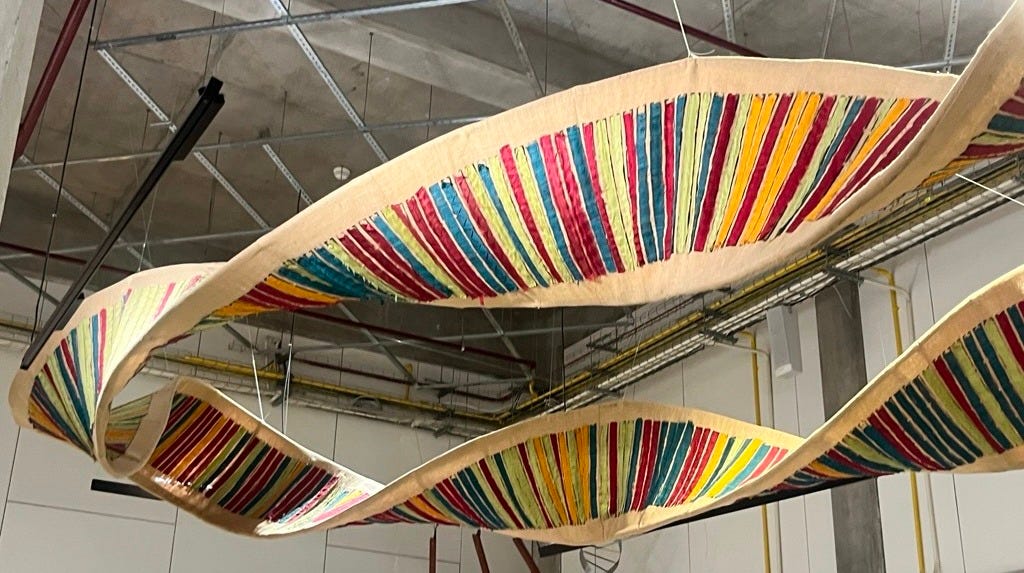
Today, the floating DNA appears calm, balanced and complete. It leaves behind a simple question: How do you bring many separate pieces together into a coherent whole?
To know more about the Human Genome Project read here: The Human Genome Project