
The role on paper
When the role was first described to our partnerships team intern stepping into her first job, it sounded neat:
Coordinate with schools.
Stay in touch with volunteers.
Keep track of schedules
She approached the role with seriousness: listening more than speaking, trying to understand how decisions travelled and who they affected. She was attentive to details, double-checked dates and sometimes even followed up on the tiniest things – she wanted to get everything right.
Even in the early days she sensed that much of the onus of this work was in conversations and judgement calls rather than clear instructions.
To keep our school programs – Khoj, Debate and Growth Mindset – running meant holding a role at the centre of many connected parts. And at the heart of those parts were our volunteers — people who gave their time expecting to do meaningful work. What we did not yet fully grasp was how much of this role relied on unspoken, practical know-how, and we wouldn’t until something slipped.
Uncertainty rears its head
A school for the Khoj programme had been finalised months in advance – dates locked, confirmation emails exchanged, and later, volunteers briefed. On the morning of the visit, the team of volunteers were given their final confirmation yet again after some back and forth with the school, just to be sure.
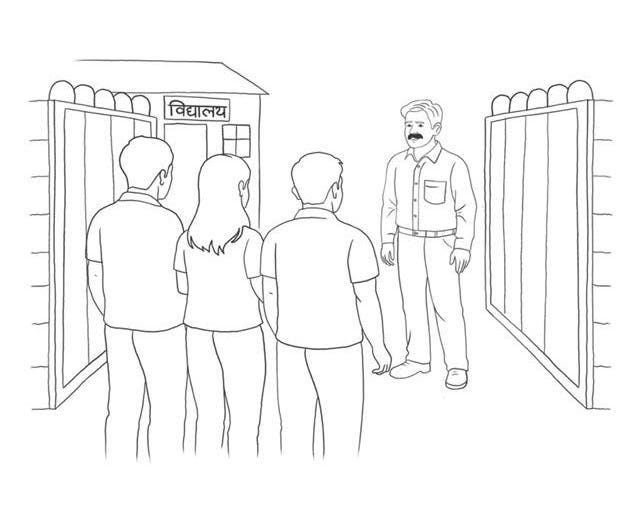
And yet, when the volunteers reached the gate, they were not allowed inside.
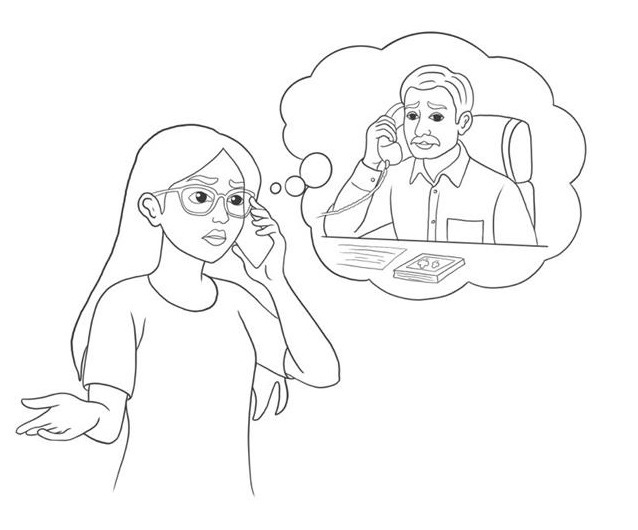
The principal who had approved the programme had left months earlier. The new management had no record of the collaboration. What the volunteers experienced in that moment was confusion, disappointment, and the awkwardness of being turned away despite being ready to contribute. Through the day, she moved between calls – speaking to the new principal, the school director, her colleagues, and the volunteers waiting outside. The school finally admitted to the miscommunication and offered to reschedule.
The human measure of running a programme
As the situation unfolded, what she kept returning to was: What does this moment feel like for the people who showed up? She wondered what it would mean to ask them to go back to the same place and still hold the same energy. Instead of pushing ahead, she chose to pause. The program was moved to another school where teachers were prepared and students were waiting. The session ran well - but the earlier moment stayed with us because it showed how quickly a system gap can affect the experience of our volunteers.
When she reflected on the incident, she spoke about the support that helped her navigate it - a teammate guiding conversations, the team backing her decision, and the space to think beyond immediate fixes. But what stood out most was how she learned to hold multiple perspectives at once: the school’s internal issues, organisational timelines, and most importantly, the time and emotional investment of volunteers.
That balance became her reference point: decisions were not only about whether a programme could happen, but whether it could happen in a way that respected the people showing up to make it possible.
What we learned
For us, the incident became a reminder of what sits at the centre of our work.
On the surface, it looked like a scheduling problem. A visit didn’t happen. Plans had to change. But what stayed with us was something else: a group of volunteers had arrived ready to give their time, and we hadn’t created the conditions for that effort to land the way it should have. That part was ours to own. We had trusted earlier confirmations and moved ahead, without building enough checks to be sure the space would be ready.
It made us realise how easily uncertainty can stay hidden. Everything can look fine until suddenly it isn’t, and by then the weight has already shifted onto the people on the ground. In this case, that meant volunteers waiting outside a school gate, unsure what had happened.
We also saw more clearly that good intentions are not enough to create a good experience. Programmes run well when communications are clear, confirmations are on paper, and follow ups happen routinely. Without these, even committed teams and volunteers end up facing unpredictability rather than the work they set out to do.
This experience continues to shape how we think about responsibility: as something that needs to be built into the way we work, every day.
What stayed with us
At its heart, this is not only a story about an intern learning through a difficult moment.
It is about an organisation recognising that the quality of a programme is measured not only by whether it runs, but by how it feels for the people who make it possible. Our employee’s experience helped us see more clearly that our responsibility is not just to design meaningful engagements, but to safeguard the conditions in which volunteers can offer their time with confidence.
And in looking back, the incident becomes less a disruption and more a turning point - one that reminded us of where the true intention of our work lies.