
For ten days, by Udaipur’s Fateh Sagar Lake, people stopped to admire the ordinary.
Under a bamboo installation built entirely from sustainable materials, Dharohar’s contribution to the annual Garden at Pal flower show invited visitors to walk through, touch, and learn about Rajasthan’s grasses. Indigenous grasses preserved in Jungle and Johadbeed formed the centre, creating a different rhythm within flowers, blooms, and colour. Early mornings and late afternoons saw families pause to make anthotypes under the winter sun and children gather around broom-making demonstrations.
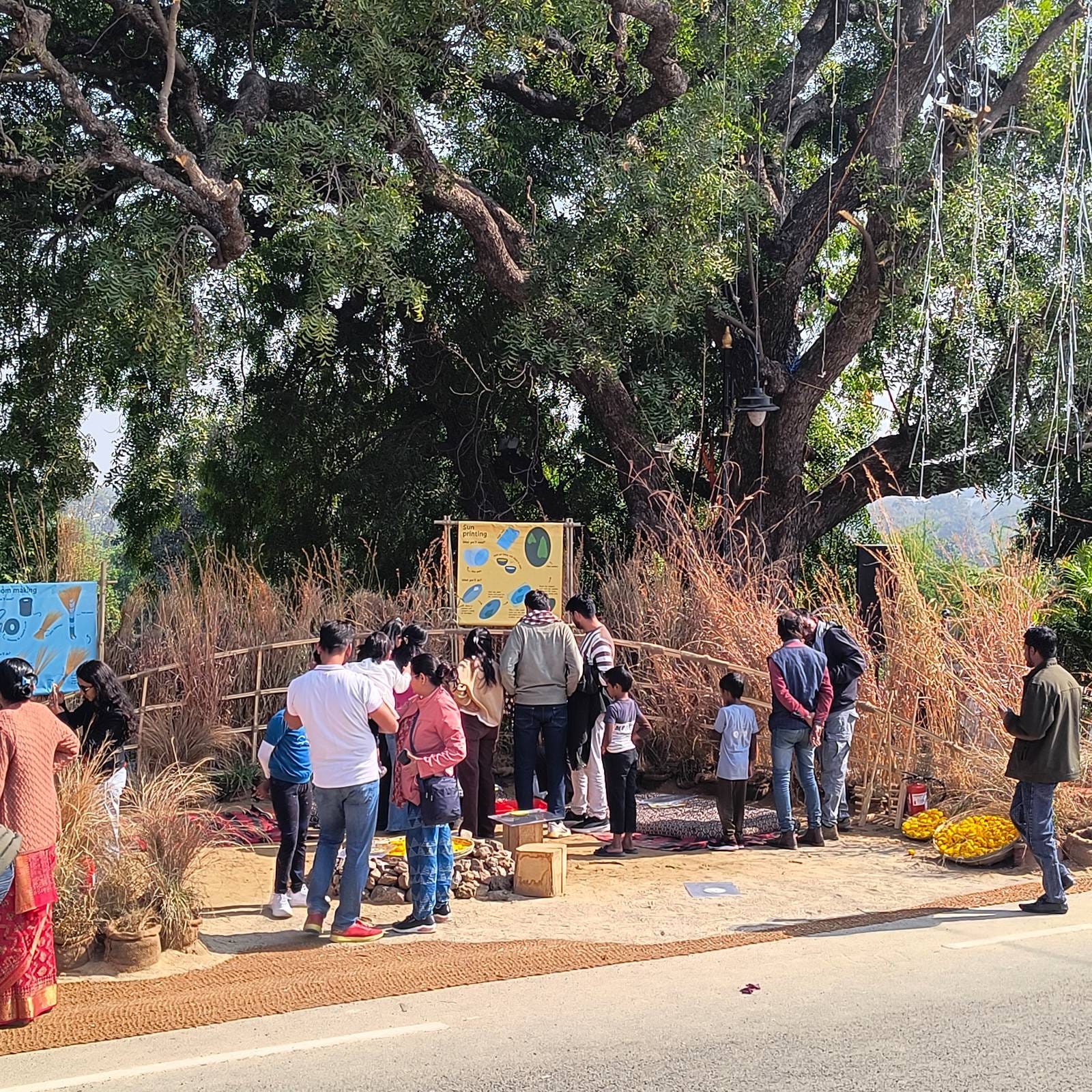
The project carried months of work before it opened. Studio Saar continuously developed designs that could hold both the realities of a public space and the kinds of interactions Dharohar wanted visitors to have with the grasses. At Third Space, Nandita ma’am, Nandini and other team members coordinated logistics, activities, partnerships, and visitor experience. They also worked on shaping the learning material around the grasses, researching them and simplifying dense information into something accessible for visitors across age groups. Within the team, the installation was already understood as one of Dharohar’s biggest public projects of the season.
Kinjal, who had recently joined Third Space as a science lab facilitator, entered the project through a much smaller role: having noticed the anthotype activity she conducted in the lab, Nandita ma’am approached her to help prepare materials for the same. The activity depended on sunlight which would produce beautiful naturally pigmented impressions of grasses. The request immediately excited her.
“I get to talk to people about science,” Kinjal remembers thinking. “Nothing could be more exciting.”
At first, the work seemed straightforward. Kinjal spoke to team members already involved, tried understanding the grasses and the activities, and focused on preparing materials. SOPs were shared, instructions documented, and supplies arranged. But one part of the project remained uncertain: who would anchor the learning experience on-ground and interact with visitors throughout the ten days?
A few days before opening, things began shifting. Some team members were on leave, and questions slowly started moving toward whoever was available. Calls came asking Kinjal to visit the venue, inspect the setup, and help make decisions around the activities.
“What mattresses are going there?”
“How is the setup supposed to look?”
“What materials are required on-site?”
As responsibility reached her gradually through a series of immediate needs that had to be addressed in real time, Kinjal remembers not knowing how to answer most of these questions.
The next morning, she drove to the site to check on preparations.
The setup area was an uneven patch of damp ground. Standing there, she found herself thinking through practical details: whether cushions would survive the mud, where materials could be stored safely, whether mats would create extra cleaning work, and how visitors would be comfortable inside the structure.
Soon, Kinjal was coordinating between Third Space, Studio Saar and the venue, responding to questions, and arranging last-minute materials. On opening day, she also stepped in to facilitate the anthotype activity. She sat with visitors explaining the science behind it, interestingly, the exact kind of interaction that had drawn her into the project in the first place.
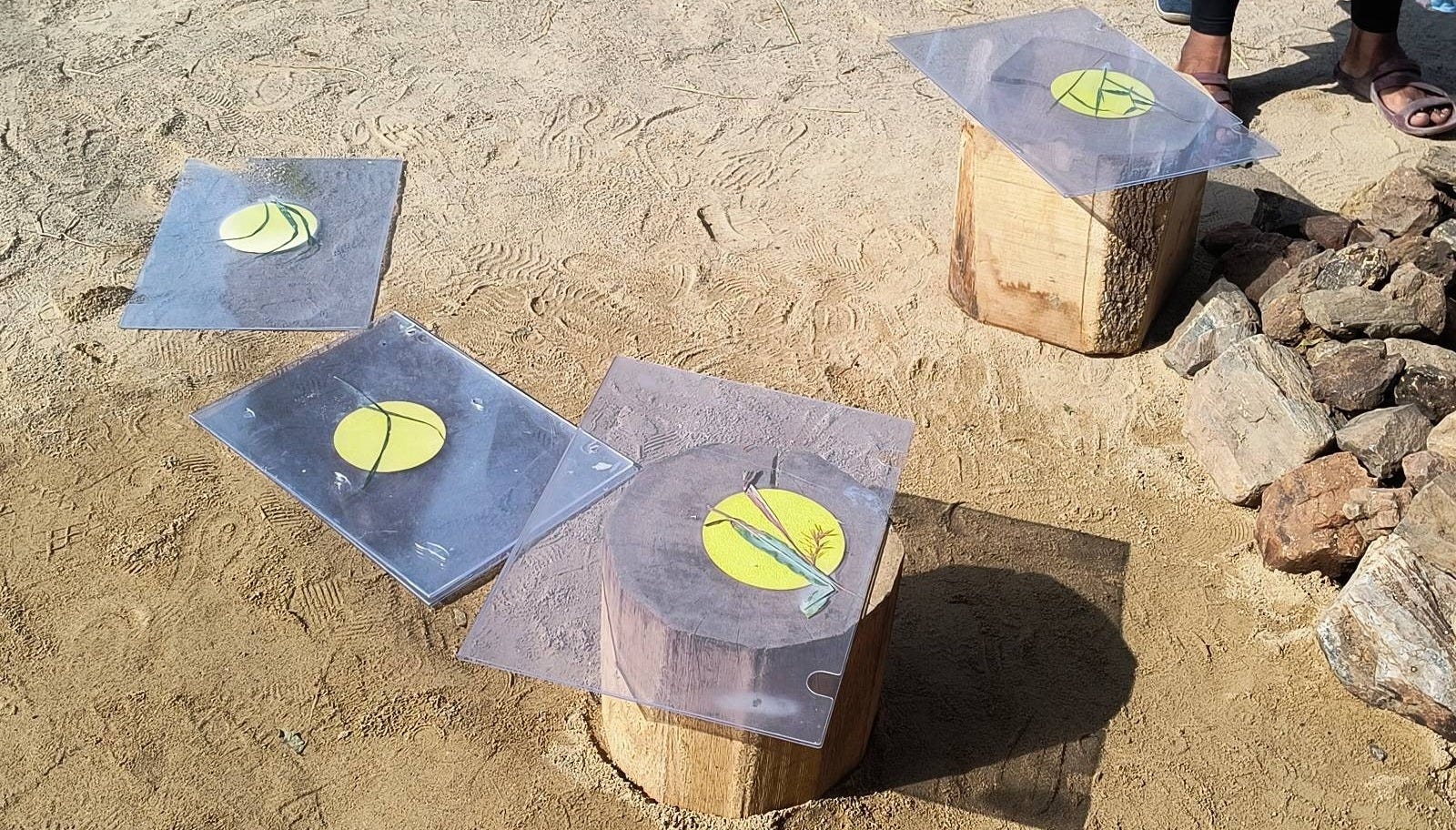
Once opened for visitors, the installation continued to run through shared effort. Team members moved constantly between responsibilities: managing visitors, troubleshooting logistics, setting up activities, and coordinating supplies. Effort was dynamic rather than static. Roles shifted daily, often hourly, depending on what the space needed at that moment. The requirement for on-ground interaction, however, was constant.
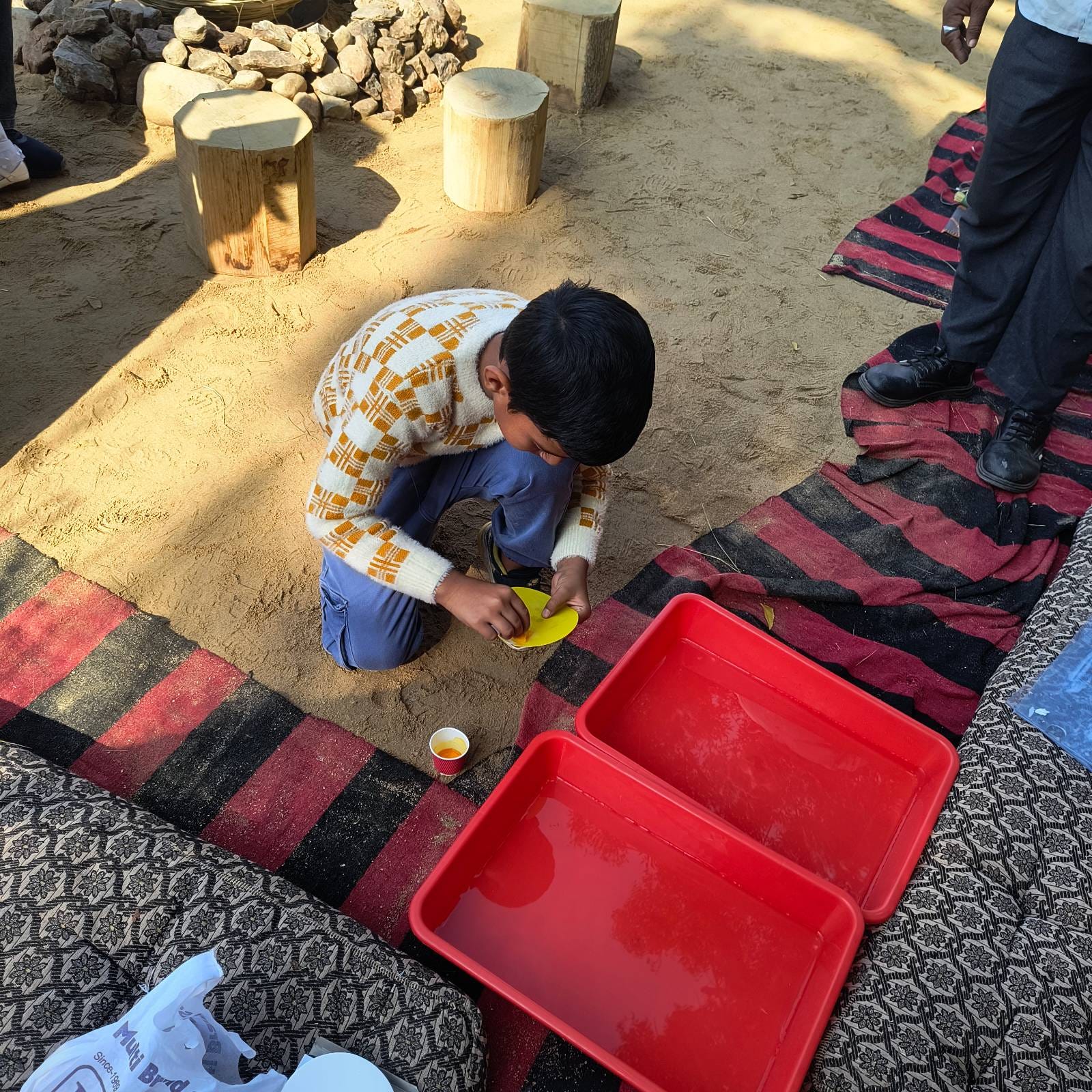
At one point, Nandita ma’am asked whether Kinjal could remain on-site continuously for all ten days. What came naturally to her, Kinjal thinks, was to simply agree and figure things out later. This time, after speaking with her team, she admitted she did not have the bandwidth. Office responsibilities, deadlines, and commuting would become difficult to sustain alongside full-time facilitation. Another solution was suggested: Kinjal could train the jungle staff members, who had been on-site setting up, to run the activities.
From there, the execution became even more collective. People were no longer only responsible for their assigned roles; they were constantly stepping into one another’s work to keep the installation functioning through the day.
In many ways, this stretched the team’s abilities. Jungle staff members who had initially been involved in setting up the space were now learning how to interact with visitors. But the shift also revealed the limits of solving problems in real time. Many of them were stepping into these roles at the last minute, still trying to understand the activities and the larger intention behind the installation. At times, they hesitated or gave minimal explanations. For whoever was visiting the space, the experience varied across the ten days, shaped briefly by who was facilitating and how comfortable they felt.
Looking back, Kinjal remembers the experience fondly: visitors stayed, engaged, and returned to the activities, though on some days she also noticed stretches when activities went unfacilitated and anthotype materials requiring careful handling had been left exposed to the sun.
It also left Kinjal with a set of lingering questions. Events like these, public-facing, high-stakes, and constantly unfolding across multiple teams as well as in the presence of visitors, had drawn her far outside her comfort zone. The experience was energising in some moments and overwhelming in others. In the process, this is what stayed with her:
How is responsibility truly divided in a team?
In “figuring things out,” when does adaptability end and avoidable strain begin?
And what does success even look like in moments of stretch, pressure, and uncertainty?